Surat Saree Wholesale Market: How Resellers Buy Safely in 2026
In July 2025, after floods ran through more than a hundred of Surat's textile markets, a local broker told ETV Bharat that sarees which had retailed at ₹1,000 to ₹2,000 were being sold off at ₹35 to ₹50 a kilo. In Surat, a price that looks too good usually has a history behind it, and the reseller who asks about that history is the one who keeps their margin. This guide covers how the market works and how to check that the person on WhatsApp is who they say they are.
About 40% of India's man-made fabric is produced in Surat, according to the trade portal Fibre2Fashion, so a good share of the polyester and georgette sarees sold online has probably passed through it. That scale is the opportunity, and it is also why sellers in our research kept repeating the same warning: fake manufacturers are many, and the cheapest lot is rarely the best one.
यह गाइड हिंदी में पढ़ें
This guide does not name or recommend any wholesaler or shop. A list of "top saree wholesalers in Surat" is only as good as the day it was written; what lasts is a way to judge any supplier yourself. I am based in Surat myself, and where a fact below comes from news or trade press rather than an official source, it says so.
How Surat's textile trade is organised
Surat's wholesale trade sits in a belt of market complexes along Ring Road and in the Saroli area. These are multi-storey buildings, each holding hundreds of small shops. FOSTTA, the Surat textile traders' federation, put the size of the trade at more than 75,000 trading shops in 220 textile markets, with a turnover of nearly ₹1.5 lakh crore a year, in remarks reported by Textile Excellence in June 2026. Older counts are lower, so treat any figure as approximate.
The making mostly happens elsewhere in the city. According to Fibre2Fashion, power looms and processing units are clustered in areas such as Pandesara, Sachin and Katargam, and the city has the whole chain in one place: yarn, weaving, dyeing, printing and embroidery.
So four kinds of people may offer you sarees, and it helps to know which one you are talking to.
| Who | What they do | What to watch |
|---|---|---|
| Wholesale trader (a shop in a textile market) | Buys from weavers and processors, adds designs and finishing, sells in sets across India. | The most common seller. Prices and minimums vary by shop. |
| Manufacturer (weaving, printing or embroidery unit) | Makes the fabric or the finished saree, usually in the loom and processing areas rather than in the markets. | Many sellers online call themselves manufacturers. Ask to see the unit on a video call. |
| Reseller or online trader | Buys from the first two and sells on WhatsApp, Instagram or B2B apps, often in smaller quantities. | Good for small orders, but you pay their margin and they are hardest to verify. |
| Agent or broker (dalal) | Connects outstation buyers with traders and is paid by commission. | Be clear who pays them, and never send money through them. |
Between established firms, the trade runs on credit: FOSTTA describes a 180-day credit window as the norm and has discussed cutting it to 70 days, according to a January 2026 report. That credit is for parties who know each other, often introduced by a broker. A new reseller should not expect it.
The main markets, and where they are
People searching for the "Surat saree wholesale market address" are usually hoping for one building, and there isn't one. Sarees are sold across dozens of complexes in the belt. The markets below are ones named in news and trade reporting, with their approximate location: starting points for a visit, not recommendations.
| Market | Location, as reported | Source |
|---|---|---|
| Surat Textile Market (STM) | One of the best-known complexes in the Ring Road belt | Fibre2Fashion |
| Radha Krishna and Millennium markets | Named among the major complexes in the Ring Road and Saroli areas | Fibre2Fashion |
| Shivshakti Textile Market | Ring Road | DeshGujarat, Feb 2025 |
| Raghukul Market | Near the Kamela drain; more than 500 shops were flooded in July 2025 | ETV Bharat, Jul 2025 |
| Shyam Sangini market | Saroli; reported as stocking ready-made garments and cloth | DeshGujarat, Sep 2026 |
Some websites assign each market a speciality, one building for sarees and another for dress materials. I could not find a reliable source for those labels, so they are left out. Specialities really live at the level of the shop, and the quickest way to find the right floor is to ask a shopkeeper in the first market you visit. Confirm opening days and hours with the trader before you travel.
How buying works: sets, payment, invoice and transport
Sets, not pieces. As sellers describe it, wholesale shops usually sell a design as a set or catalogue: several pieces of the same design, often in different colours, sold together. The minimum depends on the shop and the design, and sellers in our research named high minimums as a big problem when starting out. Ask whether you can mix colours or take a half set; some traders will bend for a buyer they hope to see again.
Payment. Whether you pay at the counter or by UPI or bank transfer from home, pay to an account in the name of the firm you are buying from, and keep the screenshot with the WhatsApp chat where the order was agreed.
GST invoice. Sarees are treated as fabric for GST and taxed at 5% at any price, under the rates that came into force on 22 September 2025. Ask for a GST invoice on every purchase, even a small one. It is your proof of what you bought and from whom, and with a regular GSTIN (not composition or an Enrolment ID), it is how you claim the GST you paid as input tax credit. A lower price for "no bill" buys you a purchase you cannot prove.
Transport. Outstation orders usually go through a transport company or parcel agent serving the markets; the trader books the parcel and you collect it in your city. Ask for the docket or LR number as soon as it is booked. A consignment worth more than ₹50,000 needs an e-way bill under the GST rules (see the GST Council's e-way bill note), which matters once you scale up.
Before you pay anyone for the first time, get answers to these.
| Ask for | Why |
|---|---|
| Your GSTIN, and the firm name on it | So you can check it on the GST portal before any money moves. |
| Minimum per design, and whether a set can mix colours | A mixed or half set is easier on a small budget. |
| Exact fabric, length, and whether a blouse piece is included | These go in your listing. A wrong fabric name is a return. |
| GST invoice with every dispatch | Your proof of purchase, and your input tax credit if you hold a regular GSTIN. |
| Which transporter, and the docket or LR number after dispatch | So you can track the parcel yourself. |
| What happens if pieces arrive damaged or different | Agree it in writing on WhatsApp before you pay, not after. |
How to buy from Surat without visiting
Plenty of the trade already runs remotely. Fibre2Fashion notes that where out-of-town buyers once inspected fabric in person, many negotiations now happen over WhatsApp images and videos before goods are shipped. A photo can be of anything, so the job is to turn photos into evidence.
Start with a live video call, not a recorded video. Ask the trader to show the shop board with the market name and shop number, then unfold the specific sarees you are discussing and show the border and pallu. A real shop can do this in two minutes, and someone reselling a stranger's catalogue will find reasons not to.
Then place a sample order: one set, or a few pieces if the trader allows, paid in full. When it arrives, check it against the photos and the chat. If the sarees match and the invoice is in order, you have a supplier worth a second order. If anything is off, stop there and try another trader.
Red flags: how to spot a fake Surat supplier
The scam sellers describe most often: an attractive catalogue on WhatsApp or Instagram, a price a little below everyone else, a demand for full payment in advance, then silence or a parcel of something else. Surat now has a dedicated textile police station for payment defaults, fake firms and forged documents, Textile Excellence reported in June 2026, and FOSTTA puts fraud losses in the trade at nearly ₹500 crore a year. Traders get cheated too: a complaint filed in August 2026 concerned sarees taken on credit by outstation traders who then vanished. A genuine trader should not mind being checked.
Check the GSTIN on the GST portal. This takes two minutes and needs no login. Go to gst.gov.in, open Search Taxpayer and choose search by GSTIN/UIN. Type the 15-character GSTIN, enter the captcha and click Search. The portal's own guide lists what you will see: legal name, trade name, effective date of registration, constitution of business (proprietorship, partnership, company), principal place of business, a cancellation date if cancelled, and returns filed.
Read the result like this.
- The registration should be active. A cancellation date, or a notice that the GSTIN is suspended, means stop.
- The principal place of business should be in Surat, or wherever the supplier says they are.
- The legal name or trade name should match the business name on their catalogue, shop board and invoice.
- Returns should have been filed. A GSTIN that has filed nothing for months is not one to pay in advance.
- A registration from last month is not proof of fraud, but with a big discount and pressure to pay, it is a reason to slow down.
The check proves a registration exists and is in good standing. It does not prove the person messaging you owns it, since anyone can copy a real trader's GSTIN off an old invoice.
Match the bank account to the trade name. The payee name that shows when you add the account or UPI ID should match the legal or trade name on the GST portal. An unrelated personal account, or a last-minute change of account details, is a reason to stop.
Never pay a full advance to a new contact. For a first order, pay for a sample in full or pay part in advance with the balance on dispatch, against a GST invoice and docket number.
Other warning signs: no live video call; catalogue photos that appear on other sellers' pages (a reverse image search shows this); a price far below every other quote; no GST invoice; "only today" pressure.
If you are cheated after paying online, report it quickly. The government's National Cyber Crime Reporting Portal at cybercrime.gov.in asks any victim of financial cyber fraud to call the helpline 1930. Report it as soon as you can.
Why cheap stock turns into returns
Go back to the sarees selling by the kilo after the 2025 floods. Stock like that is a legitimate trade at the right price for a buyer who knows what it is. The trouble starts when a reseller buys a cheap lot without asking why it is cheap, photographs the one good piece, and lists the lot as new. Each water-marked or damp-smelling piece is then a return waiting to happen.
Returns are where saree margins disappear. On Meesho, for example, you pay the return shipping when a customer sends a saree back, and sellers report ₹157 to ₹175 on a light parcel; our guide to selling sarees on Meesho shows how a return buffer changes your price. As an illustration with assumed numbers: a saree bought ₹60 cheaper that comes back one time in four has already lost most of that saving to return fees. Before listing stock from a new supplier, check every set.
| Check | How |
|---|---|
| Colour | Compare it in daylight with the supplier’s photo. |
| Fabric and weight | Does it feel like the fabric named on the invoice? A fabric that does not match its description is a likely return. |
| Length and blouse piece | Measure one piece per set; check the blouse piece is there. |
| Border, pallu and work | Look for loose zari, missing sequins, crooked printing and pulled threads. |
| Finishing | Check that fall and pico are done if the listing says so. |
| Damp and storage marks | Smell the fold and look for tide marks, especially on a lot sold cheap after the monsoon. |
Then photograph the sarees you actually received. The supplier's photo may be of an edited sample, and Meesho's saree rules ban photos with a logo or watermark, which rules out any wholesaler image still carrying one. The clothing photoshoot guide covers doing this well at home, and the product photography cost guide shows what a studio would charge if you would rather hand it over.
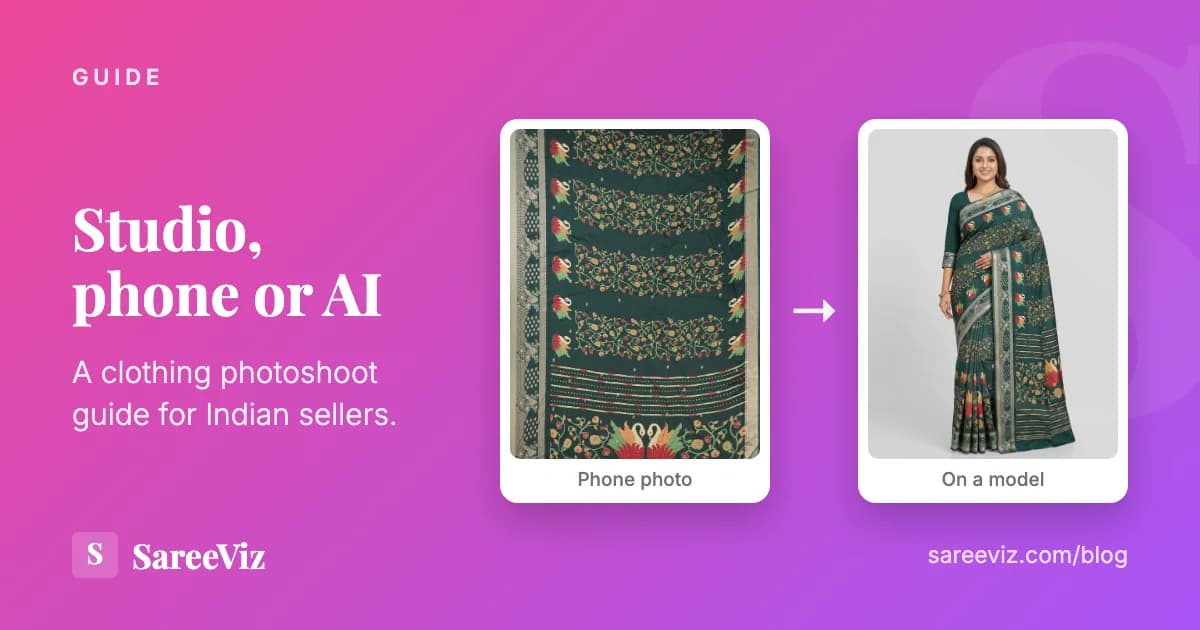
A flat phone photo can also become an on-model photo. SareeViz, which is our product, does this from a single photo of the saree; the Meesho product photography page shows a before and after. Whatever you use, hold the real saree next to the screen before you list, and fix any colour or border that is a shade off.
Frequently asked questions
Surat saree wholesale market kaha hai? (Where is it?)
Most of Surat’s wholesale textile markets are along Ring Road and in the nearby Saroli area, in large multi-storey complexes with hundreds of shops each. Surat Textile Market, Radha Krishna and Millennium are among the best-known complexes. There is no single saree market; sarees are sold across many of these buildings.
Surat se saree kaise mangwaye? (How to order from Surat?)
Check the trader’s GSTIN on the GST portal, see the actual pieces on a live video call, and place a small first order paid to a bank account in the firm’s name. Ask for a GST invoice and the transporter’s docket number, and check every piece before you list it.
How do I know if a Surat saree supplier is genuine?
Search their GSTIN on gst.gov.in using Search Taxpayer, which needs no login. Check that the registration is active, that returns have been filed, and that the name matches both the business and the bank account you are asked to pay. Then ask for a live video call and start with a small order, not a full advance.
What is the minimum order quantity for sarees in Surat?
There is no fixed rule. As sellers describe it, most wholesalers sell a design as a set of several pieces, often in different colours, and the minimum varies by shop and by design. Ask whether you can mix colours or buy a half set for a first order.
How much GST is charged on sarees bought wholesale?
Sarees are treated as fabric for GST and are taxed at 5% at any price, under the rates in force from 22 September 2025. Ask for a GST invoice on every purchase. If you hold a regular GSTIN, the GST on that invoice can be claimed as input tax credit; composition and Enrolment ID sellers cannot claim it.
Try It Free
Photograph your new stock on a model with 5 free credits
Lay the saree you received flat, take one phone photo, and check the result against the real saree before you list it.
Try SareeViz Free →