Ecommerce Photography in India: AI vs Traditional Photoshoot (2026)
Most shoppers decide from the photo before they read a word. The real question is not whether good photos matter, it is whether you still need a studio and a model to get them. Here is what ecommerce photography costs in India right now, and what changes when you use AI instead.
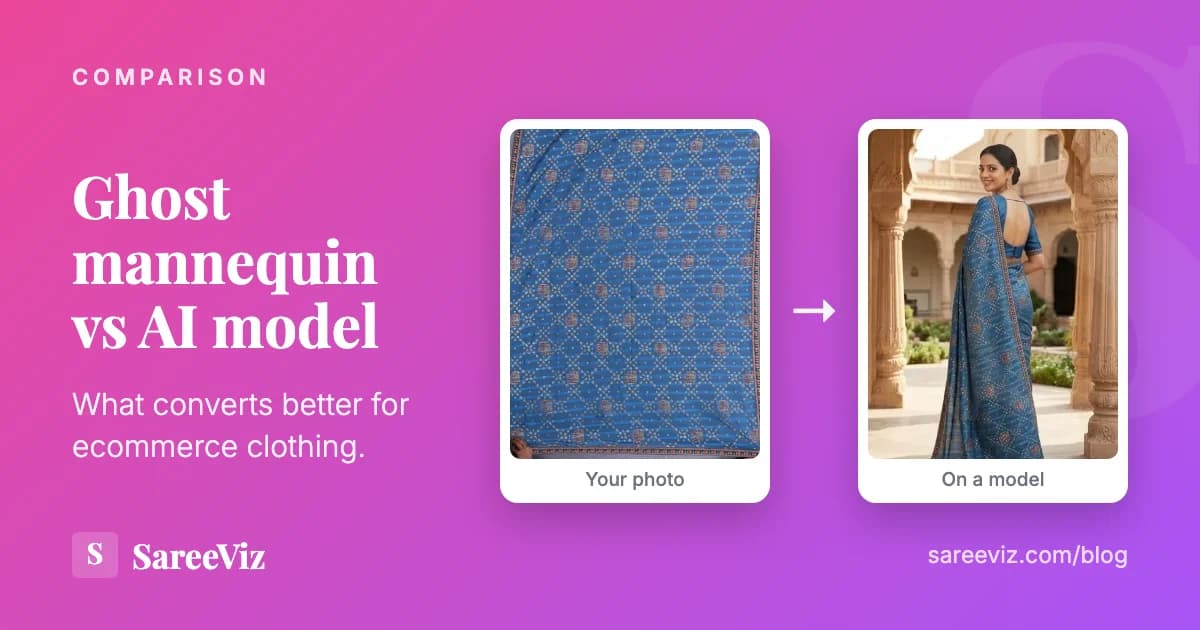
AI-generated model photo (right) vs traditional studio shoot. Buyers increasingly can't tell the difference.
The state of ecommerce photography in India (2026)
Indian ecommerce is experiencing a catalog arms race. On Meesho, where over 15 lakh sellers list products, buyers scroll through hundreds of sarees per search. The brands that win are often those with the most professional, consistent, and voluminous product images — not necessarily those with the best-designed sarees.
Traditional product photography has been the quality benchmark for years. But at ₹300–₹1,000 per image (including studio, model, photography, and editing costs), it's economically impossible for boutiques and small manufacturers to photograph their full seasonal catalog. Many sellers go live with only 10–20% of their inventory photographed, leaving significant revenue on the table.
AI product photography has changed this equation. In 2026, AI-generated images consistently pass the quality bar for all major Indian marketplaces and convert at competitive rates with traditional photography — at 2–5% of the cost.
Cost comparison: Traditional vs AI photography
Here's a realistic breakdown of what each approach costs for Indian fashion brands at different catalog scales:
Traditional Photoshoot Costs (India, 2026)
| Cost Item | Typical Range |
|---|---|
| Studio rental (half day) | ₹4,000–₹8,000 |
| Model hire | ₹5,000–₹15,000 |
| Photographer | ₹5,000–₹20,000 |
| Saree draper / stylist | ₹1,500–₹3,000 |
| Post-production editing | ₹3,000–₹12,000 |
| Garments shot per session (approx) | 20–50 garments |
| Effective cost per image | ₹370–₹1,160 |
| Catalog Size | Traditional Cost | AI Cost (SareeViz) | Savings |
|---|---|---|---|
| 25 garments | ₹9,250–₹29,000 | ₹250 | ₹9,000–₹28,750 |
| 50 garments | ₹18,500–₹58,000 | ₹500 | ₹18,000–₹57,500 |
| 100 garments | ₹37,000–₹1,16,000 | ₹1,000 | ₹36,000–₹1,15,000 |
| 200 garments | ₹74,000–₹2,32,000 | ₹2,000 | ₹72,000–₹2,30,000 |
Quality comparison
Traditional Photography
- Highest possible image quality ceiling
- Real model expressions and body language
- Complex lighting and editorial setups
- Inconsistent across sessions (different lighting, models)
- Very slow turnaround (days to weeks)
- High cost makes full catalog coverage impossible for SMBs
AI Photography (SareeViz)
- Catalog-grade output that meets all marketplace specs
- Perfect consistency across entire catalog
- Instant turnaround — under 1 minute per image
- Affordable enough for full catalog coverage
- Cannot replicate complex editorial/campaign aesthetics
- Quality ceiling below top-tier fashion photography
Speed and scalability comparison
| Factor | Traditional | AI (SareeViz) |
|---|---|---|
| Booking lead time | 1–3 weeks | Immediate |
| Shoot to image delivery | 5–14 days | Under 1 minute |
| Reshoot turnaround | 2–4 weeks | Minutes |
| New product listing speed | 2–4 weeks from manufacture | Same day |
| Seasonal catalog refresh | 4–8 weeks | 1–2 days |
| Maximum daily output | 40–60 images | Unlimited |
What ecommerce photography costs in India
Prices vary a lot depending on the city and whether you go to a studio or hire someone to come to you. These are the ranges sellers actually report in 2026.
| What you are buying | Typical price | Worth knowing |
|---|---|---|
| Flat-lay product shot | ₹150 to ₹400 per image | Cheapest option, but flat-lays convert worse than on-model |
| Ghost mannequin shot | ₹300 to ₹600 per image | Shows the shape without a model. Editing is what costs, not the shoot |
| On-model studio shoot | ₹500 to ₹1,000 per image | Model, photographer and studio are usually billed per day, not per image |
| Full day studio package | ₹25,000 to ₹60,000 | Covers roughly 30 to 60 products if everything runs on time |
| AI, with SareeViz | ₹10–₹25 per image by resolution | No minimum, no booking, done the same day |
If you are searching for ecommerce photography services near you, the number that usually decides it is not the per-image price but the minimum order. Most studios will not take a job under about 20 products, which is a problem when you add five new designs a week.
Where ghost mannequin fits in
Ghost mannequin, sometimes called invisible mannequin, is the style where the garment appears to hold its shape with nobody inside it. You dress a mannequin, shoot it, then edit the mannequin out. It is popular because it shows fit without paying for a model.
It sits between a flat-lay and a full model shoot on both price and result. Shoppers can see how the garment hangs, which a flat-lay cannot show, but there is no person to make it feel wearable. For sarees in particular it struggles, because so much of a saree is in the drape and the fall of the pallu, and a mannequin cannot show that.
We compared the two approaches in detail in ghost mannequin vs AI model photography, including when the mannequin route still makes sense.
Image rules on Indian marketplaces
Whatever route you pick, the photo has to pass the platform's rules. These change from time to time, so check before uploading a whole catalogue, but the essentials have been stable.
Meesho
Plain white or light background, product filling most of the frame, no text or watermarks on the main image, minimum 500x500 pixels.
Amazon India
Pure white background for the main image, product taking up at least 85 percent of the frame, 1000 pixels or more on the longest side so zoom works.
Myntra
On-model images strongly preferred for clothing, consistent framing across a catalogue, higher resolution than most platforms.
Flipkart
White background for the main image, no borders or promotional text, multiple angles encouraged in the secondary slots.
The common thread is a clean background and a clear product. That is exactly what AI output gives you by default, which is why it usually passes on the first upload.
A worked example: sarees
Sarees are the hardest case for every method, which makes them a useful test. Six metres of fabric, a border that customers zoom into, and a drape that changes the whole look. A flat-lay hides all of it. A mannequin cannot drape properly. So sarees have always meant a real shoot, or nothing.
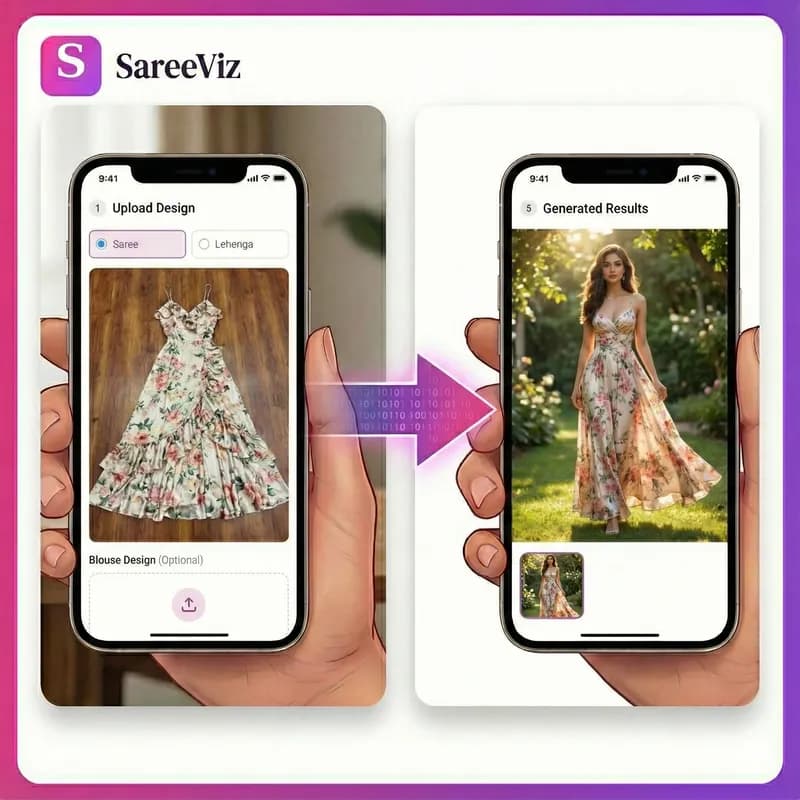
This is where the cost gap bites hardest. A boutique adding ten new designs a week cannot book a studio ten times a month, so most designs go up as flat-lays and sell worse. AI closes that gap: the same phone photo of a flat saree becomes an on-model image in about a minute.
If sarees are your category, saree photo editing with AI walks through the whole process, and saree draping software covers the draping side specifically. For everything else, the ecommerce photography page shows the formats we output for each marketplace.
When traditional photography is still worth it
AI product photography excels at catalog-scale listing images. But traditional photography remains the better choice for:
Brand campaign imagery
Hero images for brand launches, Diwali campaigns, or premium brand storytelling. These benefit from the artistic direction, model charisma, and production value that real shoots provide.
PR and editorial
Magazine features, blog collaborations, and editorial content require real photography. AI images rarely pass the editorial bar for fashion press.
Premium D2C positioning
If your brand is positioned as ultra-premium (₹10,000+ per saree) and competes on exclusivity, real photography signals quality in a way AI still doesn't fully replicate.
ROI calculation: A real example
Here's a worked example for a Surat-based saree brand with 120 active designs on Meesho and Amazon. Surat is not a random choice: in our analysis of 207,556 catalogue images, Gujarat sellers produced 65% of all the images we saw.
Old Workflow (Traditional)
New Workflow (SareeViz)
By switching to AI photography, this brand saves ₹58,800 in photography costs per season and unlocks 40 previously unphotographed designs — potentially adding significant monthly revenue.
Frequently asked questions
Is AI product photography quality good enough for Meesho and Amazon India?
Yes. AI product photography tools like SareeViz produce images that meet all marketplace image requirements for Meesho, Amazon India, Myntra, and Flipkart. In 2026, it's the standard approach for fast-growing Indian fashion brands — both established sellers and new entrants are using AI photography for primary product listing images.
How does traditional photography compare to AI in terms of return rates?
Industry research indicates that 22% of product returns happen because the item looked different online than in person. On-model AI images (which show garment drape and fit more accurately than flat-lays) can reduce this mismatch. There's no specific data comparing AI vs traditional model shots for return rates — quality of execution matters more than the method.
What's the ROI of switching to AI product photography?
For a typical Indian saree seller with 100 designs, switching from traditional photography (₹500–₹1,000/image) to SareeViz (₹20 per 4K image) saves ₹48,000–₹98,000 per catalog cycle. Even accounting for the time cost of input photo preparation, the return is typically 20–50x within the first season.
Are there situations where traditional photography is still worth the premium?
Yes. For hero campaign images for large brands, lookbook editorial photography, print advertising, and premium D2C brand storytelling, professional traditional photography with experienced photographers and real models remains valuable. AI photography is best for catalog-scale product listing images, not brand-defining campaign work.
Can I mix AI and traditional photos in my product listings?
Yes. Many sellers use AI-generated model images as their primary listing images (first photo the buyer sees) and supplement with traditional lifestyle photos in secondary image slots. This maximises catalog coverage with AI efficiency while retaining brand feel in supporting images.
See the Difference
Try AI product photography today — from ₹10 per image
No studio booking. No model hire. No editing wait. Just upload your garment photo and download your catalog image.
Try SareeViz Free →