Ghost Mannequin Photography: How It Works, What It Costs, and Where AI Models Fit
Somewhere in every ghost mannequin photo is a second photograph you never notice: the inside of the back collar, label and all, shot separately and pasted into the neck hole. Ghost mannequin photography is the craft of making a garment look worn by nobody, and that patch of collar is how the trick is done.
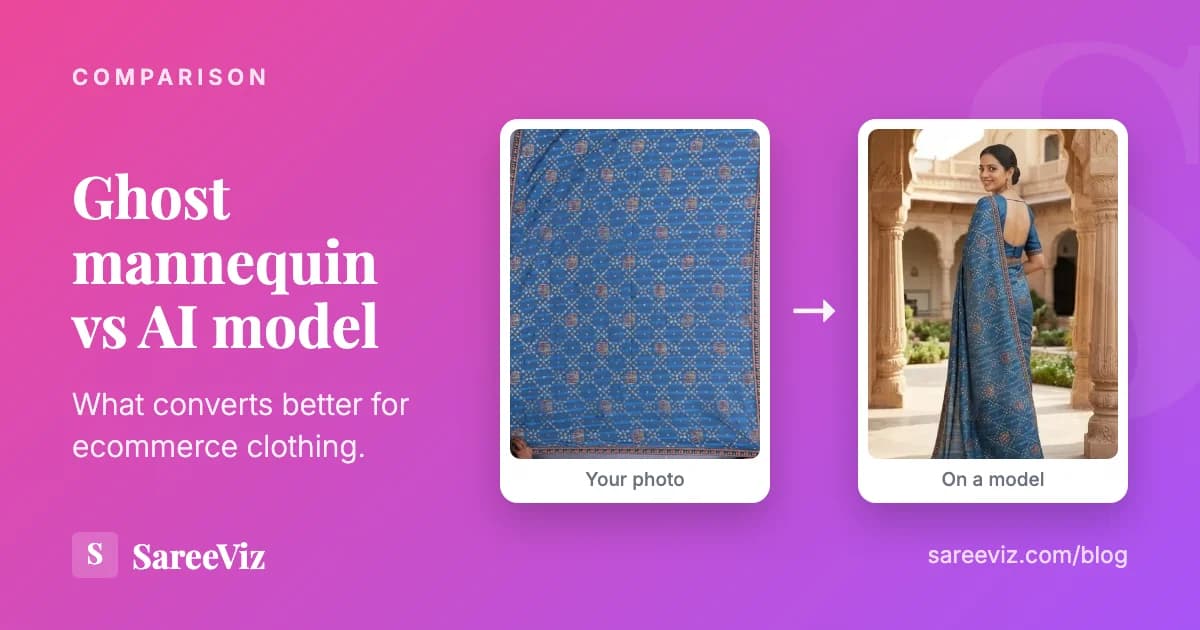
A flat product photo, and the same saree on an AI model: the route this post compares against the ghost mannequin.
What is ghost mannequin photography?
Ghost mannequin photography is a way of photographing clothes on a mannequin and then removing the mannequin in editing, so the garment appears to float with its full 3D shape: shoulders, neckline and the fall of the body, with nobody inside. Pixelz, a product-photo editing service, describes it as a post-production technique “also known as the ‘invisible mannequin,’ ‘3D mannequin,’ or ‘hollow man’”. A Delhi studio's guide puts it the same way for Indian sellers: the apparel is photographed on a mannequin, which is then digitally removed.
Its appeal is that it sits between the two other cheap options. A flat lay shows the design but not the shape, and a visible mannequin shows the shape but looks, to put it kindly, like a shop window. The ghost version keeps the shape and loses the mannequin. It also makes a whole catalogue look consistent, because every garment is shot the same way from the same angle.
Ghost mannequin: works well for
- Blazers and structured jackets
- Formal shirts and trousers
- Knitwear with complex shapes
- Outerwear and coats
- T-shirts and polos in bulk
Ghost mannequin: less effective for
- Sarees (draping is the product)
- Flowy dresses and skirts
- Lehengas and dupattas
- Lightweight, sheer fabrics
- Garments where movement matters
How ghost mannequin photography is done
The mannequin is a special one. FASHN's guide describes it as having “removable panels (neck, chest, arms) so the mannequin can hide inside the garment”, and puts torso versions at around $300 and full-body systems above $1,000. An Indian studio's guide gives INR 4,000 to INR 25,000 for mannequins in the Indian market.
Shoot the garment on the mannequin
Front and back, with the neck and any arms removed or positioned out of frame, under lighting you will not change for the rest of the set.
Shoot the inside
The inner back collar, label included, and for some garments the inside of the back and the sleeves. Pixelz suggests laying the garment on white foam board for these shots, in exactly the same light.
Composite in editing
The retoucher removes the mannequin and layers the inside shot underneath, keeping, in Pixelz's words, "that neckline triangle between the shoulders". This is where most of the cost sits.
Clean up and export
Background to white, colour matched to the real fabric, shadows and seams tidied so the join is invisible.
FASHN's guide estimates that experienced retouchers spend roughly 10 to 30 minutes per image, and up to an hour for structured outerwear. That editing time is why the price of a ghost mannequin photo depends so much on the garment: one join at the neck of a T-shirt is quick, while a jacket with a collar, two sleeves and a lining is not.
What ghost mannequin photography costs in India
These are published prices, read in September 2026. None of them says GST is included.
| Who | What | Listed price |
|---|---|---|
| M-Picspro, New Delhi | Ghost mannequin shoot | ₹100 per image |
| Ckstudio, Delhi | Ghost mannequin shoot, by volume and complexity | ₹150 to ₹300 per image |
| Ckstudio, Delhi | Package: 10 products, 2 images each | ₹1,500 |
| Ckstudio price guide | Budget to premium studio tiers | ₹250 to ₹800 per product |
| Path, editing only | Simple join (one place, such as a T-shirt neck) / complex join | $0.89 / $1.79 per image |
The editing-only route looks cheapest, and it is, if you already own a ghost mannequin, lights and a camera and have someone to run them. For most small sellers the studio price is the real one. For the wider picture, including flat lays and on-model shoots, our guide to product photography cost in India collects the published rate cards.
Ghost mannequin AI: what the new tools do
“Ghost mannequin AI” now means two quite different things, and it is worth knowing which one you are looking at.
The first kind makes the ghost mannequin effect itself, without the multi-shot edit. Photoroom's ghost mannequin tool accepts “any clothing photo, whether it's a flat lay, hanging garment, mannequin, or model image” and reconstructs the hidden parts of the garment with AI. FASHN's Packshot does a similar job from a flat, hanger, mannequin or on-model photo, with the ghost mannequin look as its default, at 1 credit per 1K image on plans from $19 a month for 200 credits. If your buyers expect a floating-garment catalogue, as many Western wear and basics sellers do, these tools replace the retoucher.
The second kind goes the other way: it takes a flat lay, a hanger shot or an existing ghost mannequin photo and puts the garment on a person. That is what SareeViz does. You upload the garment photo, choose a model and pose, and get an on-model photo in about a minute. If you already have a library of ghost mannequin photos, they work as the upload, so a catalogue shot on a mannequin can get on-model images without a reshoot. Our step-by-step walkthrough covers the input photo and model choice.
Upload your garment photo
A ghost mannequin photo, a flat lay or a hanger shot. Only the garment in the frame, in even light; the photo prep guide has the rules.
Pick a model and pose
Or pick a marketplace preset, which sets the poses, background and output for Myntra, Amazon, Flipkart or Meesho.
Generate and check
About a minute per image. Check the print, colour and trims against the real garment before you keep it.
Download and list
Up to 8K resolution, in the shape your marketplace asks for.
Before uploading, read the photo prep guide. A mannequin cannot drape six metres of fabric, so if sarees are your category the route is AI saree photography, which takes the blouse piece as its own upload.
The in-between option: a mannequin, kept in the shot
There is a third look, and SareeViz makes it. In the model menu, beside the human looks, sits an option called Mannequin. Pick it and the garment comes back on a realistic, faceless dress form, either headless or with a plain neutral head, fitted to show the garment's true silhouette and drape, on whichever background you choose. It is the no-person catalogue look that basics and kidswear sellers often want, made from the same flat photo and at the same price per image as a model shot.
Be clear about what it is not. The mannequin stays in the picture. There is no invisible-mannequin edit, no hollow neck showing the inside label, and no second photo stitched in, so if your brand or marketplace wants the true floating ghost mannequin effect, the tools in the first group above do that job. Two practical limits: the Mannequin option cannot be combined with a marketplace preset, because a preset locks the model choice, and it is greyed out once you upload your own model photo.
Ghost mannequin vs AI model photography, head to head
| Factor | Ghost mannequin (studio) | AI model (SareeViz) |
|---|---|---|
| Cost per image | Listed from ₹100 to ₹300 at Delhi studios | ₹10 to ₹25 plus 18% GST |
| What you need | Ghost mannequin, lights, a retoucher, or a studio booking | One phone photo of the garment |
| Time to a finished image | A shoot plus 10 to 30 minutes of retouching per image | About a minute per image |
| Shows the garment worn | No, the shape only | Yes, on a model |
| Sarees and ethnic wear | Poor: a saree has no shape until it is draped | Built for it, blouse piece included |
| Amazon main image, adult clothing | Not allowed | Allowed, tagged as AI-generated people: on-model is what Amazon asks for |
| Shows the inside and construction | Yes, the collar and lining are part of the photo | No |
SareeViz prices are per image by resolution, from our pricing page; credits are only taken for images that generate successfully. Studio prices are from the table above.
What the research says about ghost mannequin vs on-model photos
You will find confident percentages online for how much ghost mannequin photos lift conversion over flat lays. I went looking for where those numbers come from and could not find a primary source for any of them, so they are not repeated here. What does exist is less tidy and more useful.
Baymard Institute, which runs usability testing on ecommerce sites, found that for apparel, cut-out images of the product on a white background “are simply not enough for users to get a sense of the clothing's physical qualities”, and recommends real human model images. It also found that “mannequins or virtually rendered ‘models’ should be considered only as a last resort, as test participants generally responded negatively to such images.” That second line is a fair warning to AI model tools as much as to mannequins: an on-model photo only helps if it reads as a real person wearing the real garment.
The one large behavioural study I found is from eBay Research Labs in 2014, on dress listings. Items shown on a person had a sell-through rate of 47.94% once clicked, against 42.45% on a mannequin and 41.88% laid flat, and a separate user study ranked the same order: person, then mannequin, then flat. Two cautions: the mannequins in that study were visible ones, not ghost mannequins, and dresses are a category where fit is the whole point.
Put together, the evidence points one way for garments that are bought on how they look worn, and that includes nearly all of Indian ethnic wear. It says less about structured basics like shirts and jackets, where the ghost mannequin's clean shape and visible construction are doing real work.
What Amazon says about ghost mannequins
This one surprises sellers. Amazon's Seller Imaging Guide for Clothing and Accessories (Spring 2021) lists “Ghost mannequins” and “Visible mannequins” among the things a product's main image must not contain, and says “All adult apparel should be imaged on-model.” Kids' and baby clothing go the other way and must be shown off-model. Ghost mannequin photos can still fill the other image slots, but the first image a shopper sees has to be on a model.
If that model is AI-generated, there is one more step. In a Seller Central announcement, Amazon now requires images with photorealistic AI-generated people to carry the keyword “contains-synthetic-performer” in their metadata before upload, and an Amazon staff reply says compliance has been mandatory since 6 June 2026. Amazon then shows shoppers an indicator that the image includes AI-generated people.
Our Amazon product photography page sets out the rest of Amazon's clothing image rules and how the Amazon preset meets them.
When ghost mannequin is still the right choice
Structured tailoring
Blazers, suits and structured jackets, where the shoulder line and lapels are the product and a clean shape says more than a pose.
B2B and wholesale catalogues
Retail buyers judging construction want to see seams, stitching, lining and pocket placement, and a ghost mannequin shows the inside of the garment in a way a model shot cannot.
Kids and baby clothing on Amazon
Amazon wants these off-model, so a clean ghost mannequin or flat shot is the format the rules ask for.
Large basics ranges
Fifty colours of the same T-shirt read best as one consistent grid, and an AI ghost mannequin tool now makes that grid without a retoucher.
Frequently asked questions
What is ghost mannequin photography?
Ghost mannequin photography, also called invisible mannequin or hollow man photography, is a way of photographing clothes on a mannequin and then removing the mannequin in editing. The finished photo shows the garment with its 3D shape, as if worn by an invisible person, with nothing visible inside it.
How much does ghost mannequin photography cost in India?
Published prices from Indian studios in 2026 run from ₹100 a photo on one Delhi listing to ₹150 to ₹300 a photo at a Delhi studio, and ₹250 to ₹800 per product across budget to premium tiers in one Delhi price guide. Editing only, where you shoot and a service does the mannequin removal, is sold abroad from $0.89 a photo for a simple neck join.
Can I use ghost mannequin photos on Amazon?
Not as the main image for adult clothing. Amazon's Seller Imaging Guide for Clothing and Accessories lists ghost mannequins and visible mannequins among the things a main image must not contain, and says all adult apparel should be imaged on a model. Ghost mannequin photos can go in the other image slots.
What is a ghost mannequin AI tool?
An AI ghost mannequin tool makes the invisible mannequin effect from an ordinary photo, such as a flat lay, a garment on a hanger or on a mannequin, without the multi-shot editing. Photoroom and FASHN both offer one. It is a different job from an AI model tool, which puts the garment on a person.
Can I turn my ghost mannequin photos into on-model photos without reshooting?
Yes. SareeViz takes an existing ghost mannequin photo as the design upload and puts the garment on a model, so a catalogue already shot on a ghost mannequin does not need a new shoot to get on-model images.
Does ghost mannequin work for sarees?
Not well. A ghost mannequin shows a garment's shape, and a saree has no shape until it is draped. Six metres of fabric on a mannequin shows the border and colour but not how the pleats, pallu and blouse sit together, which is what a saree buyer is judging.
The verdict
For sarees, lehengas, kurtis and the rest of Indian ethnic wear, a ghost mannequin is the wrong tool: the garment's shape comes from the draping, and a mannequin cannot drape. AI model photography gives those sellers the on-model image that the usability research favours and that Amazon asks for on the main image, from a phone photo and at a per-image price a studio cannot match.
For structured Western wear, kids' clothing and wholesale catalogues, the ghost mannequin still earns its place, and AI ghost mannequin tools have made it much cheaper to produce. Plenty of sellers will end up using both: a ghost mannequin shot for construction, and an on-model shot to sell.
If the AI model route is where you land, our comparison of AI fashion model generators ranks the tools, and the ecommerce photography page shows the finished output formats.
Try It Free
Put your ghost mannequin shots on a model
Upload a ghost mannequin photo, a flat lay or a hanger shot, and get an on-model catalogue image in about a minute.
Try SareeViz Free →