How to Reduce Returns and RTO on COD Orders: A Guide for Ethnic-Wear Sellers
Some women's ethnic-wear brands that take about eight in ten orders on cash on delivery report RTO of 40 to 60%: orders that never reach the buyer and come back unopened. That range comes from founder and seller discussions we read in October 2026, not from an industry study. For a seller shipping COD from their own store, every one of those parcels was paid for twice, once on the way out and once on the way back.
This guide is for people selling sarees, kurtis and lehengas on Meesho, their own website, Instagram or WhatsApp. It separates the two ways an order comes back, because they have different causes and costs, then covers what you can change in each place you sell. Platform facts come from each company's own pages, linked, as they read on 22 October 2026; where a number comes from seller reports, it says so.
A disclosure: SareeViz, which publishes this blog, makes AI model photos for sarees. It comes up once, in the section on photos. The rest applies whatever you use.
RTO and customer returns are two different bills
RTO stands for Return to Origin. The courier tried to deliver, the buyer refused the parcel or could not be found, and it went back to you. A customer return is the other kind: the buyer took the parcel, opened it, did not like it, and asked for a refund. Sellers often lump the two together as "returns", which hides the fact that the fixes are almost completely different.
| RTO | Customer return | |
|---|---|---|
| What happened | The parcel never reached the buyer. They refused it, were not home, or the address was wrong. | The buyer took the parcel, opened it and sent it back. |
| Who usually causes it | A buyer who changed their mind before paying, or bad address and phone details | A buyer who did not like what arrived, or ordered two sizes to keep one |
| Cost on your own store | Forward shipping, plus the courier’s RTO charge, plus packing | Whatever your return policy offers, plus reverse pickup if you pay for it |
| Cost on Meesho | No extra fee, per Meesho’s shipping page | A return shipping fee by weight; sellers report ₹157 to ₹175 |
| Condition when it comes back | Usually sealed, sometimes crushed | Opened, sometimes worn, sometimes not your saree |
On your own store, RTO is the expensive one: you pay for the trip out, the trip back and the packing, and earn nothing. Here is a worked example. Every number in it is an assumption; replace each with your own, taking shipping and RTO charges from your courier's rate card.
Assume a saree sold at ₹899 on COD that costs you ₹400, with ₹80 forward shipping, ₹80 to bring an RTO back, and ₹15 of packing. A delivered order leaves you ₹404 before any COD handling fee your courier adds. An RTO costs you ₹175 and hands the saree back to you to sell again.
| RTO rate (assumed) | Profit on every 10 orders shipped |
|---|---|
| 10% (1 of 10 come back) | ₹3,461 |
| 20% (2 of 10 come back) | ₹2,882 |
| 40% (4 of 10 come back) | ₹1,724 |
Going from one RTO in ten to four in ten costs this seller ₹1,737 on every ten orders, before counting a saree that comes back crushed. On Meesho the sums run the other way, as the Meesho section shows.
Why COD orders fail
Cash on delivery lets a buyer order with no money at stake, and some treat it like a wishlist. A buyer orders after a late-night reel, and by the time the parcel arrives four days later they have bought something locally, or the cash is not in the house. The parcel is refused at the door, and nobody loses anything except you.
Other RTOs are not changes of heart at all. An address with no landmark, a wrong pincode or a phone number missing a digit turns a willing buyer into an RTO. Delivery time matters too: the longer a parcel takes, the longer the buyer has to cool off.
Pull your last fifty RTOs and sort them by the courier's reason. Mostly "customer refused" means the work is in confirming intent before you ship; mostly "address incomplete" or "not reachable" means it is in the details you collect at checkout.
Cutting RTO on your own store and WhatsApp orders
Confirm every COD order before you pack it. A short WhatsApp message or call ("Your Banarasi saree, ₹899, cash on delivery to this address, shall we send it?") catches the impulse orders while they are still cheap to cancel. It costs nothing but time, and it is one of the fixes sellers mention most.
Make prepaying worth a little. A small prepaid discount, or free shipping only on prepaid orders, moves some buyers off COD. For high-value lehengas and silk sarees, many sellers take a part payment up front, sometimes just the shipping amount, with the rest on delivery. A buyer with ₹100 already paid has much less reason to refuse the parcel.
Check the address like a courier would. House or flat number, a landmark, a pincode that matches the city, and a phone number with ten digits. Fix it with the buyer before dispatch, not after the first failed attempt.
Use your own data on pincodes. After a few months you will see that some pincodes send back far more parcels than others. Turning COD off there, while keeping prepaid open, is fairer and more precise than switching off COD for everyone.
Act on non-delivery reports the same day. When an attempt fails, the courier sends an NDR, a Non-Delivery Report. That is your last chance to call the buyer, fix the address or agree a new day. Some sellers stop asking for redelivery after two failed attempts with a buyer who has refused or gone silent, so the stock comes home sooner; that is their practice, not a courier rule.
Shipping aggregators package some of this into features. Shiprocket's NDR management page describes one dashboard for undelivered orders, reattempts the same or next day, and buyer outreach by SMS, email and automated IVR calls (IVR only on its higher plans), and claims it can "reduce RTO up to 10%", which is Shiprocket's own figure. A Shiprocket support article, last updated in July 2024, adds an RTO Score for risky orders, address verification and COD management that nudges risky buyers towards prepaid. GoKwik, a checkout tool, says on its own site that it helps "spot risky shoppers with RTO insights". None of these pages give prices, so check features and charges with each company first.
Cutting RTO and returns on Meesho
Meesho runs the checkout and the buyer relationship, so the confirmation calls and pincode switches above are not tools you have there. What Meesho's shipping page does tell you is what each outcome costs. When an order comes back as RTO, after the courier has tried three times, Meesho charges no fee. When a buyer accepts the parcel and returns it, which they can do within 7 days of delivery, you pay a return shipping fee based on weight. Sellers report that fee as ₹157 to ₹175 on a light parcel. Meesho's pricing page adds that it takes no collection fee on COD orders.
So on Meesho, RTO costs no fee, though it still ties up a saree for a week or two. The leak is the customer return: on a ₹400 saree, one return fee can cancel the margin on two or three good orders.
Build a return buffer into the price; our guide to selling sarees on Meesho has a worked example. Dispatch well inside Meesho's two to three days, so the buyer has less time to regret the order. And make the listing match the saree, which matters most and is the next section.
"Not as shown" returns: where photos earn their keep
Ask saree sellers why customer returns come back and the answer is usually some version of "it did not look like the photo": the colour a shade off, or the fabric thinner than it looked. These are the most fixable returns, because the gap is in your listing, and you write the listing.
Photograph your own stock. Wholesaler photos are often edited for punch and sometimes not even of the same batch. Shoot the piece you will actually ship, in daylight near a window, with one wide shot and one close-up of the fabric and border. Our Meesho product photography page shows what a phone photo can look like next to an on-model version.
Check colour against the real thing. Phone cameras and editing apps love to brighten reds and deepen greens. Before you list, hold the saree next to the screen. If the rani pink on screen is not the rani pink in your hand, fix it. Our post on saree photo editing with AI covers changing a saree's colour in a photo, and where that goes wrong.
Be honest about fabric. A powerloom saree described as handloom, or a blend sold as pure silk, sells once and comes back, because buyers who know sarees feel the difference in seconds.
Give sizes in centimetres. For blouses, kurtis and lehengas, "M" means different things at different factories. A size chart with bust, waist, hip and length in centimetres, measured on the actual garment, cuts the size bracketing sellers report, where a buyer orders the same kurti in two sizes and returns the one that does not fit.
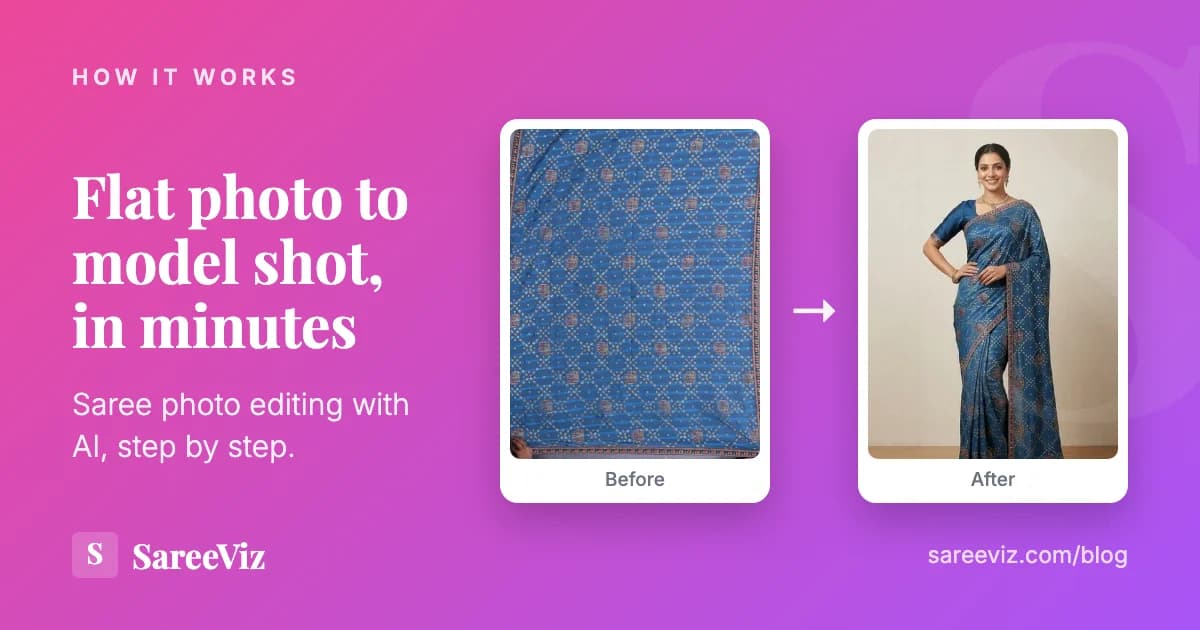
Model photos help, as long as they are accurate. Buyers are wary of AI photos that look glossy but do not match the garment. SareeViz, our tool, turns a flat phone photo of your saree into on-model photos, and we built it around keeping the real design, colour and border. Whatever you use, the test is whether the photo looks like what will come out of the box. Our photo prep guide explains how to crop the flat photo to the fabric, edge to edge, so the result keeps the real design.
Wrong and fake returns: evidence and claims
The return that hurts most is the one where what comes back is not what you sent: a used saree, a damaged one, a cheaper piece in your packet, or an empty box. Marketplace claim processes for this all run on evidence.
The habits sellers rely on are simple. Record a short, unedited video of packing each order, showing the saree, any tag and the sealed parcel with its label. Record another of opening each return, starting with the sealed packet and its label in view. Some sellers attach a small numbered tag or sticker to every piece, so a swapped saree is obvious at a glance. Keep the return packaging until the claim is settled.
On Meesho, there are two separate 7-day windows, and they are easy to mix up. The first is published: buyers can return within 7 days of delivery. The second is reported by sellers: a wrong-return claim has to be raised within 7 days of the seller receiving the return. Sellers also report claims being refused when an account files them often, though Meesho publishes no threshold. Treat the claim window and the refusals as seller experience rather than written rules, and act inside a week either way.
On Amazon.in, the equivalent is a SAFE-T claim. Amazon's own seller blog post on SAFE-T says Easy Ship sellers can claim for in-transit or customer-damaged returns, from Orders, then Manage SAFE-T claims, one claim per order ID, with supporting documents attached. That post dates from 2018, so check the current steps and eligibility inside Seller Central before you rely on it. Our Amazon photo guide covers the listing side.
The checklist
Pin this next to the packing table, and start with whichever problem is costing you most.
| Habit | Where | Cuts |
|---|---|---|
| Confirm every COD order on WhatsApp or a call before packing | Own store, WhatsApp | RTO |
| Offer a small prepaid discount or take a part payment up front | Own store, WhatsApp | RTO |
| Check the address has a house number, landmark and the right pincode | Own store, WhatsApp | RTO |
| Turn off COD for pincodes that keep coming back in your own data | Own store | RTO |
| Act on every non-delivery report the same day | Own store | RTO |
| Dispatch within a day or two | Everywhere | RTO |
| Price with a return buffer built in | Meesho, everywhere | The cost of both |
| Photograph your own stock in daylight, with one close-up of fabric and border | Everywhere | Returns |
| Hold the real piece next to the screen before you list | Everywhere | Returns |
| Name the fabric honestly: powerloom, handloom, blend | Everywhere | Returns |
| Give a size chart in centimetres for blouses, kurtis and lehengas | Everywhere | Returns |
| Video every packing and every return unboxing, tag each piece | Everywhere | Wrong returns |
| File claims early and only when you have proof | Meesho, Amazon | Wrong returns |
None of this gets RTO or returns to zero; the aim is to stop paying for the avoidable ones and to price for the rest.
Frequently asked questions
RTO ka matlab kya hai? (What does RTO mean?)
In online selling, RTO means Return to Origin: the courier could not deliver the parcel, because the buyer refused it, was not available or gave a wrong address, so it goes back to the seller. A customer return is different: the buyer accepts the parcel and then sends it back. Outside e-commerce, RTO usually means the Regional Transport Office, which handles driving licences and vehicle registration.
Meesho par wrong return aaye toh kya kare? (What to do about a wrong return on Meesho?)
Keep the packaging, record a video of opening the return with the label in view, and compare it with your packing video of that order. Then raise a claim from your Meesho supplier panel quickly. Sellers report that Meesho accepts these claims only within 7 days of the seller receiving the return, and refuses them for sellers who file very often, so file promptly and only with clear proof.
Does Meesho charge sellers for RTO?
No. Meesho’s shipping page says there is no fee on RTO, and the courier tries three times first. A customer return, where the buyer accepts the order and then sends it back, carries a return shipping fee by weight, which sellers report as ₹157 to ₹175 on a light parcel.
Should I stop offering cash on delivery?
Usually not, because many ethnic-wear buyers will only try a new seller on COD. Keep it, but confirm each order on WhatsApp or a call, reward prepaying with a small discount, take a part payment on expensive pieces, and switch COD off only for pincodes your own records show keep failing.
What is NDR in shipping?
NDR means Non-Delivery Report: the courier telling you that a delivery attempt failed and why. It is your chance to call the buyer, fix the address or agree a new date before the parcel becomes an RTO.
How do I reduce “not as shown” returns on sarees?
Photograph the saree you will actually ship, in daylight, with a close-up of the fabric and border. Check the on-screen colour against the real saree, name the fabric honestly (powerloom, handloom, blend) and give blouse and kurti measurements in centimetres. Most of these returns are a gap between what the photo promised and what arrived.
Try It Free
Make photos that match the saree, with 5 free credits
Photograph a saree flat on your phone, make on-model photos, and check them against the real saree before you list.
Try SareeViz Free →