How to Market Your Saree Business Online: What Actually Brings Orders
One silk saree brand told of paying for an ad that reached about 1 lakh people and sold nothing. A handloom brand said most of its orders come from Facebook Live, which Facebook will not let a Page use until the account is 60 days old and the Page has 100 followers. This guide compares the channels a saree seller can use, sets out what a post has to show before a stranger orders, and shows how to tell whether an ad is paying for itself.
This guide draws on what saree sellers said about their own marketing in October 2026 and on the official pages of WhatsApp, Facebook, the Silk Mark Organisation of India and India's advertising standards body. Figures that come from sellers are labelled as reports, since one shop's experience is a clue rather than a rule. A disclosure: SareeViz, which publishes this blog, makes AI model photos of sarees, and the content section mentions it once.
The channels compared for a saree seller
Each channel has its own kind of buyer, so it helps to see them side by side before choosing where to spend your evenings.
| Channel | Who buys there | What it costs | Effort | What works |
|---|---|---|---|---|
| At first, mostly people who already know you | Free to post; ads are paid | High: reels every week | Reels of the saree worn and draped, price in the caption | |
| WhatsApp Business | Repeat customers, family networks, resellers | App free; business broadcasts can be paid | Medium: replying is the work | A priced catalogue, new arrivals to saved customers |
| Facebook groups and Live | Sellers report women of 35 to 55, in the afternoon | Free | High: an hour per Live, plus someone taking orders | Each saree opened out, questions answered live |
| Marketplaces | Buyers searching by price and category | Meesho: 0% commission, you pay shipping | Medium: listings, dispatch, returns | Many catalogues, sharp prices, fast dispatch |
| Your own website | People who already know your name | Domain, store builder, payment gateway fees | Low to run, high to fill with visitors | A home for repeat buyers |
| Influencers | The creator’s followers | A free saree (barter) or a fee | Medium: finding the right person | Small creators whose audience matches your buyers |
Instagram: the shop window
Instagram is where most new saree sellers start, and where many get discouraged. Twin sisters who run a saree store in Tamil Nadu described months of regular posting that brought orders almost entirely from friends and family. That is normal. Strangers buy from an account once it looks lived in, with enough posts to scroll, real customers in the comments and prices they can see. Make it easy to walk in from the window: WhatsApp lists a free WhatsApp button for your Instagram profile and Facebook Page, so a curious buyer is one tap from a chat with you.
WhatsApp Business: where the order is closed
For many saree businesses the sale happens on WhatsApp whatever channel the buyer came from. The WhatsApp Business app is free, and adds a business profile, quick replies, labels for sorting chats, and greeting and away messages. The most useful tool is the catalogue. WhatsApp's own guide says it holds up to 500 items with up to 10 photos or videos each, grouped into collections, and you can share a whole collection or a single saree in a chat or on your Status.
For new arrivals, the free option is a broadcast list. WhatsApp's help page sets two limits: up to 256 contacts per list, and only people who have saved your number receive it. So ask every buyer to save yours. Newer business broadcasts reach people who have not saved your number, but WhatsApp offers them only to eligible users in select countries, and says the earlier version, marketing messages, is paid for each message delivered. If you see the option, check the price in the app before you send.
Sellers also describe a quieter engine: reseller groups. A wholesaler posts new designs into WhatsApp groups of resellers, who forward them to their own customers with their margin added. If your price leaves room for that margin, one good reseller can outsell your own Instagram.
Facebook groups and Live: the older buyer
Sellers keep reporting the same pattern: women of about 35 to 55 buy sarees through Facebook Live and WhatsApp, and the Lives that do well run in the afternoon. One handloom brand said most of its sales come from Facebook Live. A Live lets you open each saree out, turn it to the light and answer "is the blouse piece included?" while the buyer is still watching. Keep someone beside you writing down orders.
The catch is the entry rule. Facebook says your account must be at least 60 days old, and a Page or professional mode profile needs at least 100 followers, before it can go live. So start the Page now and post in the groups your customers use while it grows.
Marketplaces, your own website and influencers
Marketplaces bring buyers you could never reach alone, but you compete on price in a crowd. Our guide on how to sell sarees on Meesho covers the account, GST and fees, and the guides for Myntra, Flipkart and Amazon cover their photo rules.
A website is worth having once people already search for your name. Nobody finds a new saree website by accident, so build it after the other channels work, not instead of them.
Influencer collaborations get mixed reports. One ethnic-wear brand said barter collaborations (a free saree in exchange for a post) raised its prepaid orders and cut RTO, the parcels that are refused or undelivered and come back to you. Other sellers report likes and little else. Pick small creators whose followers look like your buyers. Whatever you agree, India's advertising standards body ASCI says a post needs a disclosure label even when the payment is a free product, such as #Ad or #Collaboration, placed where viewers see it and laid over the video on stories.
What a post must show before anyone trusts it
If there is one change that helps almost every small seller, it is this section. Sellers report that posts saying "DM for price" drive buyers away, and that buyers want the price, the fabric, the size and real photos up front, without having to ask. A stranger has no reason to trust a new seller, so the post has to answer the questions a buyer would ask in a shop.
| Show this | Why |
|---|---|
| Price | In the caption or on the catalogue item. A buyer who has to ask usually scrolls on. |
| Fabric, in plain words | Pure silk, art silk, cotton, georgette. If it is a blend, say so. |
| Length and blouse piece | Saree length, whether a blouse piece comes with it, and the size if it is stitched. |
| Real photos | Full drape, border, pallu, and one daylight close-up that shows the true colour. |
| Reviews and customer photos | With permission. A real buyer in your saree is the best proof a new seller has. |
| Delivery, COD and returns | How many days, whether you take cash on delivery, what happens if it does not suit. |
Every line in that table is also a return avoided. A buyer who knew the fabric was art silk does not send it back for not being pure silk, and one who saw the true colour does not send it back for being darker than the photo. Marketing that oversells brings orders that come back.
For pure silk there is one more signal. Silk Mark is a label run by the Silk Mark Organisation of India, an initiative of the Central Silk Board under the Ministry of Textiles. Its labels are attached only to pure silk products, by registered authorised users, and each carries a hologram and a unique number that a buyer can check on the Silk Mark site. Registration is a one-time charge, which the organisation's membership page lists as ₹1,180 for an individual weaver and ₹11,800 for manufacturers, retailers and boutiques, both including GST, and it asks for a GST certificate. Buyers look for it: keyword tools estimate about 1,600 searches a month for "silk mark".
Content that sells sarees
A saree folded on a bed shows its colour and little else. A buyer wants to know how it falls, how wide the border is, what the pallu looks like spread out, and whether the fabric is heavy or floats.
Draping videos. A short reel of a saree being draped, start to finish, shows the fall and the pleats in a way no photo can. It can be you or a family member, filmed on a phone by a window.
Real people wearing it. A woman walking, turning and sitting in the saree tells the buyer it will look like that on her too. It need not be a model: an ordinary person in good light looks like the buyer's own life, which is the point.
Close-ups of the border and pallu. This is where the work in a saree lives. A slow daylight close-up of the zari, weave or print does what a shop assistant does by holding the pallu up to the light.
Customer photos. A real buyer at a wedding in your saree is worth more than any shoot. Ask, and get permission before you post.
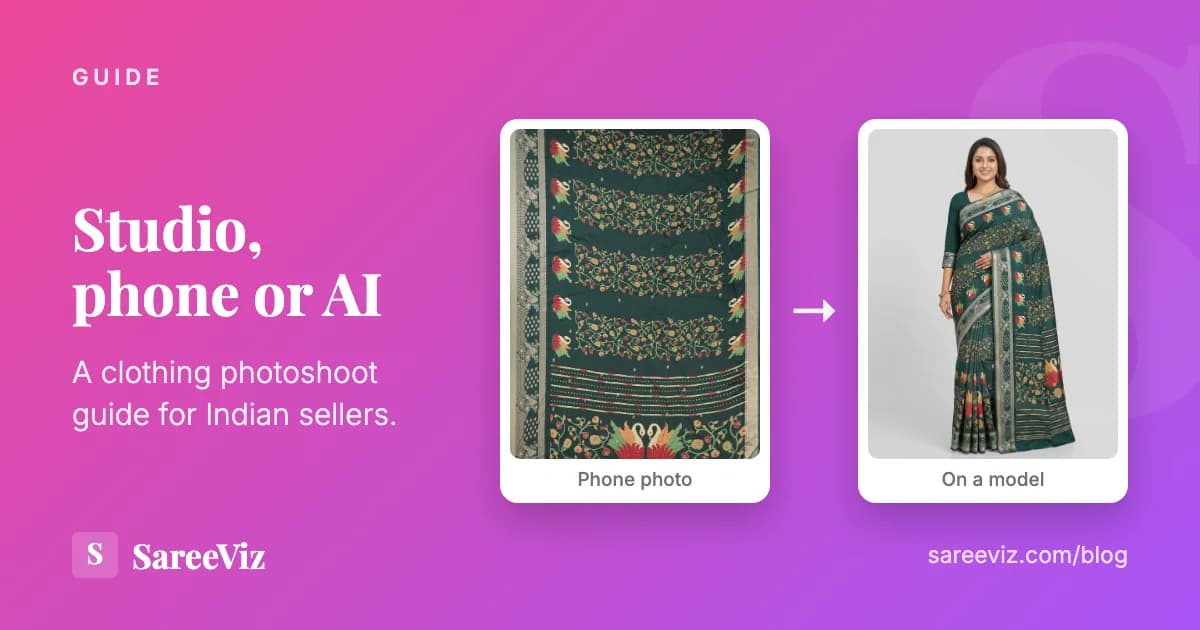
Still photos matter for the catalogue and marketplace listings. Our clothing photoshoot guide covers shooting on a phone, photo prep covers the flat-lay photo itself, and what product photography costs in India sets out what studios charge if you would rather hire one.
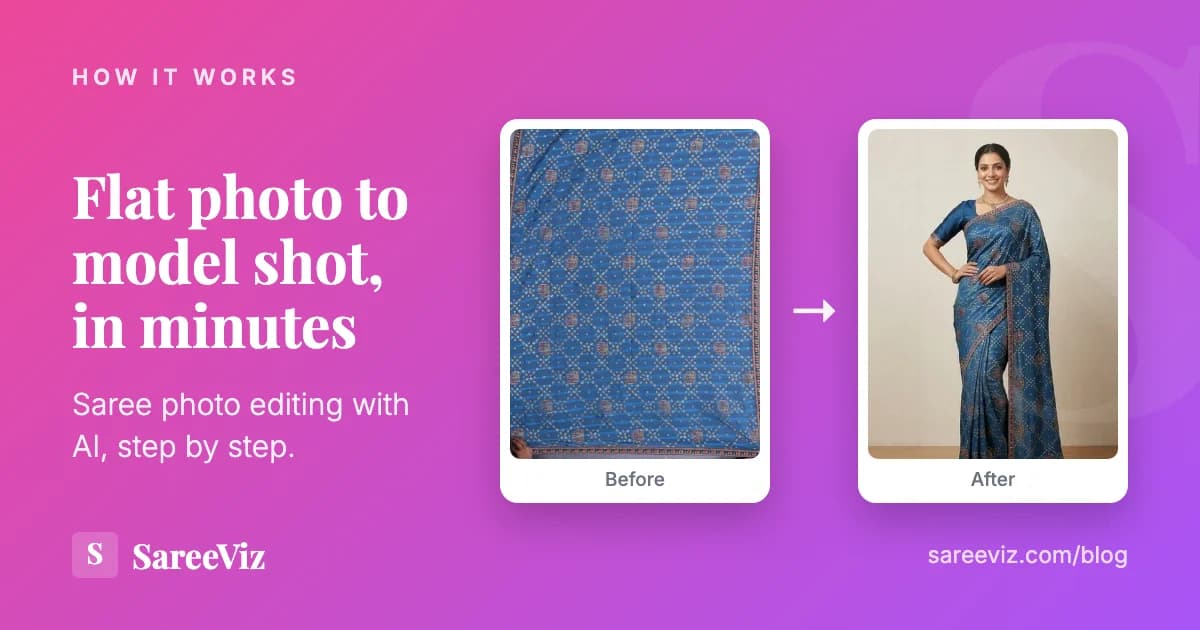
On AI photos, be careful. Sellers report that buyers distrust photos that look AI-made, and with reason: a glossy model photo where the border is subtly redrawn or the colour is a shade off is a promise the saree cannot keep. If you use AI, use it to show the real saree on a person, then hold the real saree next to the screen and check the colour, border and pallu before you post. SareeViz, which is ours, works this way: you photograph the saree flat and it makes photos of a model wearing it, at 1 credit a photo, which is ₹10 plus 18% GST at our smallest credit pack. Our guide to saree photo editing with AI covers what to check. Keep real video and customer photos alongside any AI photo.
Paid ads: when they make sense and how to judge them
Seller reports on Meta ads (Facebook and Instagram) are sobering. Sellers spending ₹10,000 to ₹15,000 a month describe paying ₹1,000 to ₹1,500 in ads for each order. One reported a ROAS of 0.8, which means ₹0.80 of sales came back for every ₹1 spent on ads, before the cost of the saree itself.
Ads tend to help a saree that already sells reach more people, rather than make an unsold one sell. Try them when a design sells steadily without ads, your posts show price and fabric, and someone answers WhatsApp within minutes, and start with one or two proven sarees. Ads that open a WhatsApp chat, which Meta offers as ads that click to WhatsApp, suit sellers who close orders in chat.
Judge the ads on what stays sold, not on reach or even orders. A worked example follows. Every number in it is an assumption; replace each with your own.
| Ad spend for the month (assumed) | ₹10,000 |
| Orders from the ads (assumed), at ₹1,200 a saree | 10 orders, ₹12,000 |
| ROAS (sales divided by ad spend) | 1.2 |
| Ad cost per order | ₹1,000 |
| Orders kept after 30% come back as returns or RTO (assumed) | 7 |
| Ad cost per kept order | ₹1,429 |
| Margin on kept orders at ₹350 each (assumed), before ads | ₹2,450 |
| Result after ad spend | −₹7,550 |
A ROAS above 1 looks like the ads are paying. Yet here the ads cost about ₹1,429 for every saree that stayed sold, while each kept saree earns ₹350, so the month loses money even before the courier charges on the returns. The test: ad cost per kept order must be lower than your margin per kept saree. Track it per saree for at least two weeks and stop the ads that fail it.
A simple weekly marketing routine
Here is a routine a one or two person business can keep up. Move the days to suit your shop; what matters is that each job happens every week.
| Day | What to do |
|---|---|
| Monday | Photograph new sarees in daylight and add them to the WhatsApp catalogue with price and fabric. |
| Tuesday | Post one reel and one carousel on Instagram and Facebook, price in the caption. |
| Wednesday | Go live on Facebook in the afternoon, or post in your buyers’ groups. |
| Thursday | Send new arrivals to saved customers on WhatsApp and to your resellers. |
| Friday | Ask last week’s buyers for a photo or review; share the ones they allow. |
| Saturday | Clear pending messages and follow up with anyone who asked a price. |
| Sunday | Write down orders, returns and RTOs by channel. |
The Sunday line is the easiest to skip. A notebook with three columns (channel, orders, orders that came back) is enough. After a month it will show which channel deserves your Wednesday afternoon.
Frequently asked questions
Instagram par saree kaise beche? (How to sell sarees on Instagram?)
Post reels of each saree being worn and draped, with price, fabric and length in the caption, and add a WhatsApp button to your profile so buyers can order in chat. Expect the first orders to come from people who know you; sellers report that strangers buy only after months of steady posting and some genuine customer photos.
WhatsApp par saree business kaise badhaye? (How to grow a saree business on WhatsApp?)
Use the free WhatsApp Business app, put every saree in the catalogue with its price, and send new arrivals to customers who have saved your number. A broadcast list holds up to 256 contacts and reaches only people who saved your number, so ask every buyer to save it. Supplying resellers who run their own groups takes you beyond your own contacts.
Should I write the price or say "DM for price"?
Write the price. Sellers report that "DM for price" makes buyers move on, and that buyers want the price, fabric, size and real photos up front.
Do Meta ads work for a new saree brand?
Often not at first. Sellers report spending ₹10,000 to ₹15,000 a month and paying ₹1,000 to ₹1,500 in ads per order. Ads work best on a saree that already sells without them. Judge them on kept orders against what you spent, not on reach.
Can I go live on Facebook with a new Page?
Not straight away. Facebook says your account must be at least 60 days old, and a Page or professional mode profile needs at least 100 followers, before it can go live.
Do I need Silk Mark to sell silk sarees?
Silk Mark is a label from the Silk Mark Organisation of India, an initiative of the Central Silk Board, that sellers register for as authorised users; it is a quality label rather than a licence to sell. It goes only on pure silk and carries a unique number buyers can check online, so for real silk it is a strong proof.
Try It Free
Make on-model photos of your sarees with 5 free credits
Photograph a saree flat on your phone, see it on a model, and check the result against the real saree before you post it.
Try SareeViz Free →